How to Solve Overheating in Chinese Restaurant Kitchens in Southeast Asia
Why Are Chinese Restaurant Kitchens in Southeast Asia So Hot?
Across Southeast Asia—including Singapore, Malaysia, Thailand, Vietnam, Indonesia, and the Philippines—Chinese restaurants are experiencing a common operational challenge: extreme heat in commercial kitchens.
Unlike many Western kitchens, Chinese cooking relies on high-powered wok burners, stir-frying, deep frying, steaming, roasting, and continuous high-heat cooking. Combined with tropical climates where outdoor temperatures often exceed 30–35°C (86–95°F) and humidity regularly reaches 70–90%, kitchen staff work in extremely demanding conditions.
Without a properly designed cooling and ventilation system, kitchen temperatures can rise well above 40°C (104°F) during busy service hours.
At LCCFAIR (Shenzhen Lanchang Technology Co., Ltd.), we help restaurants across Asia create cooler, safer, and more energy-efficient kitchens through integrated commercial kitchen climate control solutions.
Common Challenges Faced by Chinese Restaurants
Restaurant owners often believe that installing larger exhaust fans is enough. In reality, many kitchens continue to struggle because the root causes are more complex.
Common problems include:
- Excessive heat around cooking stations
- High humidity caused by steam and cooking
- Poor air circulation
- Smoke escaping from exhaust hoods
- Strong negative air pressure
- Rising electricity costs
- Staff fatigue and heat stress
- High employee turnover
- Uncomfortable working conditions
- Reduced cooking efficiency
These issues directly affect restaurant operations, food quality, employee satisfaction, and operating costs.
Why Traditional Air Conditioners Often Fail
Many restaurant owners attempt to install standard split air conditioners.
Unfortunately, residential or office air conditioners are not designed for commercial kitchens.
They often fail because they cannot withstand:
- High grease concentrations
- Continuous high-temperature operation
- Steam and moisture
- Oil contamination
- Heavy-duty daily use
As a result, cooling performance declines rapidly while maintenance costs increase.
The Real Solution: An Integrated Kitchen Climate Control System
The most effective solution is not a single piece of equipment but a balanced system that combines cooling, ventilation, and fresh air supply.
LCCFAIR recommends an integrated approach consisting of:
1. Commercial Kitchen Air Conditioner
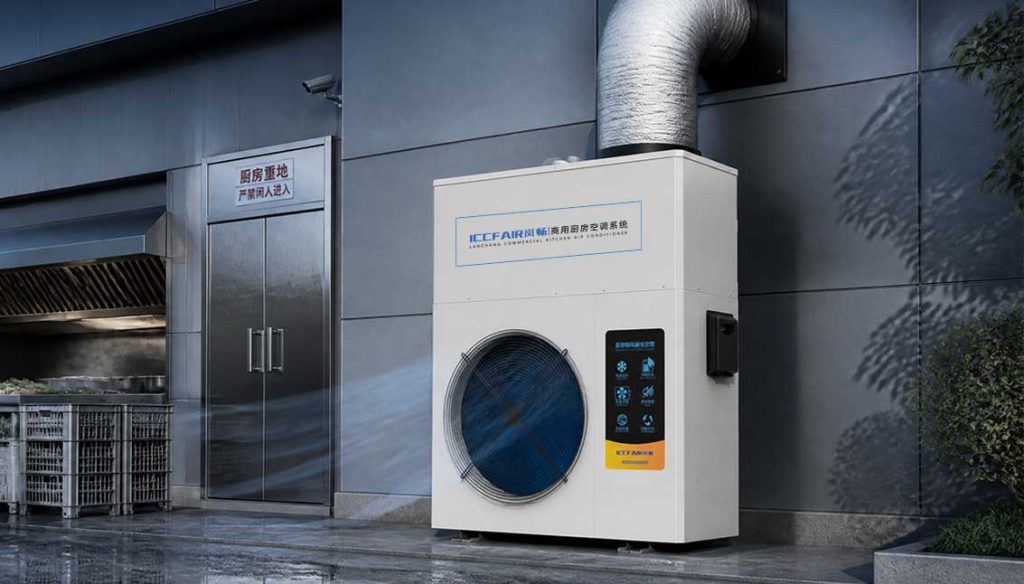
A commercial kitchen air conditioner provides targeted cooling for chefs and kitchen staff.
Unlike conventional air conditioners, LCCFAIR systems are engineered for demanding kitchen environments, delivering stable cooling performance even in high-temperature, grease-laden conditions.
Benefits include:
- Improved staff comfort
- Better productivity
- Continuous cooling
- Reduced heat stress
- Energy-efficient operation
2. Water-Cooled Fresh Air Unit
Fresh air is essential in commercial kitchens, but introducing hot outdoor air directly into the kitchen can make conditions even worse.
LCCFAIR water-cooled fresh air units cool incoming outdoor air before it enters the workspace, helping to:
- Lower indoor temperatures
- Improve ventilation
- Supply fresh air
- Reduce cooling costs
- Enhance indoor air quality
This solution is particularly effective in the hot and humid climates of Southeast Asia.
3. Kitchen Make-Up Air System
Every exhaust hood removes large volumes of air from the kitchen.
Without adequate replacement air, negative pressure develops.
A professionally designed make-up air system:
- Restores air balance
- Improves exhaust efficiency
- Prevents smoke leakage
- Enhances employee comfort
- Reduces energy waste
4. Negative Pressure Optimization
Negative pressure is one of the most overlooked problems in commercial kitchens.
Symptoms include:
- Difficult-to-open doors
- Smoke escaping into dining areas
- Reduced exhaust performance
- Hot working environments
- Increased operating costs
LCCFAIR engineers design balanced ventilation systems that eliminate negative pressure while maximizing airflow efficiency.
Industries That Benefit
Our solutions are suitable for:
- Chinese restaurants
- Cantonese restaurants
- Sichuan restaurants
- Hot pot restaurants
- BBQ restaurants
- Seafood restaurants
- Central kitchens
- Hotel kitchens
- Food courts
- Cloud kitchens
- Factory canteens
- School cafeterias
Why Southeast Asia Requires Specialized Solutions
Southeast Asia presents unique environmental challenges.
Restaurants must deal with:
- High ambient temperatures year-round
- High humidity
- Long operating hours
- Open kitchen concepts
- Heavy cooking loads
- High customer traffic
Generic cooling systems rarely perform well under these conditions.
LCCFAIR designs solutions specifically for tropical commercial kitchens, ensuring reliable operation even during peak business hours.
Why Choose LCCFAIR?
LCCFAIR (Shenzhen Lanchang Technology Co., Ltd.) specializes in commercial kitchen environmental control solutions.
Our product portfolio includes:
- Commercial Kitchen Air Conditioners
- Water-Cooled Fresh Air Units
- Kitchen Make-Up Air Systems
- Kitchen Supply Air Systems
- Commercial Ventilation Equipment
- Negative Pressure Solutions
- Industrial Cooling Systems
Our engineering team develops customized solutions based on:
- Kitchen size
- Cooking equipment
- Exhaust airflow
- Climate conditions
- Energy efficiency goals
- Customer operating requirements
Rather than selling standalone products, LCCFAIR provides complete commercial kitchen climate solutions that improve comfort, reduce operating costs, and extend equipment life.
Frequently Asked Questions
Why are Chinese restaurant kitchens hotter than other restaurants?
Chinese cooking techniques typically involve high-powered wok burners, stir-frying, steaming, and continuous high-heat cooking, generating significantly more heat than many other commercial kitchens.
Is a residential air conditioner suitable for a restaurant kitchen?
No. Residential systems are not designed for grease, steam, and continuous commercial operation. Dedicated commercial kitchen air conditioners provide better durability and performance.
How can I reduce kitchen temperature without increasing electricity costs?
A balanced combination of commercial kitchen air conditioning, water-cooled fresh air units, and properly designed make-up air systems can improve cooling efficiency while optimizing energy use.
Why is fresh air important in commercial kitchens?
Fresh air replaces the air removed by exhaust systems, prevents excessive negative pressure, improves ventilation efficiency, and creates a healthier working environment.
Conclusion
For Chinese restaurants across Southeast Asia, excessive kitchen heat is more than a comfort issue—it directly impacts staff well-being, operating efficiency, food quality, and business profitability.
By integrating commercial kitchen air conditioners, water-cooled fresh air units, make-up air systems, and balanced ventilation design, restaurants can create cooler, healthier, and more productive kitchens.
LCCFAIR (Shenzhen Lanchang Technology Co., Ltd.) is committed to delivering professional kitchen cooling and ventilation solutions tailored to the unique climate and operational needs of Southeast Asian restaurants.
Whether you are opening a new restaurant or upgrading an existing kitchen, LCCFAIR provides reliable, energy-efficient solutions designed for long-term performance in demanding commercial environments.
